Elton
The Passage (Justin Cronin Edition)Elton is a blind technician at the Lighthouse whose work helps sustain the Colony’s power and whose patient listening reaches beyond its walls. Michael Fisher’s longtime companion in the isolated station, he knows the batteries by sound and behavior, assists in searching the radio spectrum, and brings humor and kindness into Michael’s otherwise solitary life. His blindness is part of his lived experience, not an obstacle that prevents him from becoming one of the settlement’s most perceptive observers.
Identity and Life at the Lighthouse
Elton spends much of his time at the Lighthouse with Michael. Their companionship is close in practice but socially quiet: Michael recognizes that working beside Elton can still feel like being alone when it comes to conversation. The Lighthouse’s machines, radios, and control panels are their shared world, and Elton makes himself useful there day after day.
Blind from birth, Elton was born to parents among the Walkers who crossed the irradiated ruins of San Diego during the Second Wave. His mother, pregnant and delirious with fever, gave birth shortly before she died; his father’s identity was unknown. Elton grew up without knowing his parents’ names. The account distinguishes his blindness from the radiation exposure associated with the Walkers’ journey: his parents passed through the irradiated ruins, and Elton was born blind.
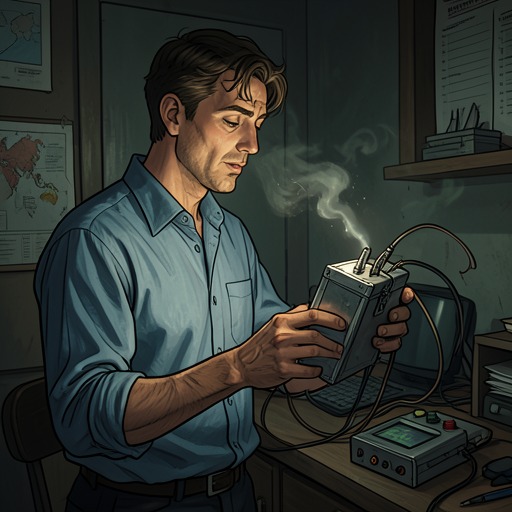
He usually remains at the control panel, using a cane when he leaves the Lighthouse. Though he has never seen the batteries he helps maintain, he knows more about them than almost anyone except Michael. Elton regards that lack of sight as an advantage: he is not distracted by what equipment appears to be and instead learns to listen to how it behaves. He puts the principle plainly to Michael: “Those batteries are like a woman, Michael,” he liked to say. “You’ve got to learn to listen.”
Work, Judgment, and the Colony’s Power
Michael and Elton’s work is both routine and urgent. Michael isolates radio signals, removes interference, and sends them through an amplifier; Elton listens through headphones and judges what may lie beneath the static. He can identify faint, irregular traces that might be a distress beacon or a ground signal, perhaps from a mine. They record the time, frequency, and other details in a logbook, then repeat the search. The process is painstaking: the spectrum holds evidence of a hidden electronic world, but no confirmed human voice answers them.
Elton’s technical judgment also helps Michael confront the Colony’s worsening energy crisis. When Michael reports that battery five is in the worst condition, two and three are somewhat better, and batteries one and four are charging irregularly, Elton understands the implications. The readings are twenty-eight that morning and never rise above fifty-five by First Bell. He projects brownouts within six months and complete failure within thirty, in line with what Michael’s father had expected. Later, when Michael explains the batteries to the others, Elton nods in support: the problem is not simply whether the system can be repaired, but what happens if the Colony fails to act.
The Lighthouse work makes Elton a partner in Michael’s technical responsibilities, not merely an audience for them. When Michael finds the old logbook, he brings it to Elton, who recognizes it as his great-grandfather’s and handles it by touch before returning it. That exchange links the station’s present investigations to a longer history of keeping records and attending to what the machines preserve.
Companionship and Care
Michael and Elton’s reliance on each other is marked by familiarity as well as friction. Michael sometimes complains about Elton sleeping at the panel or leaving the workroom in a state that makes it difficult to concentrate. Elton responds to the immediate task, asking whether Michael has soldered the component he is working on. Their exchanges show the ordinary closeness of people confined to the same workplace: irritation does not undo the trust built through shared labor.
That trust deepens when Michael searches for an unusual signal near the top of the audible spectrum, a fragment the manual lists as an unassigned frequency. Michael calls it a ghost signal; Elton answers that he could have told him it was unassigned. The signal appears after the supply party returns, when Michael is grieving Theo’s absence and blaming himself for a chain of events that led to his friend’s death. Elton does not resolve Michael’s guilt, but his presence keeps the investigation shared rather than solitary.
Elton also responds to people beyond Michael. When Sara comes to the Lighthouse after Gabe’s decline, she finds Elton asleep at the panel with his headphones on. He welcomes her and, when she is distressed that her care has not been enough, tells her that it never is. He then offers her the headphones as a gift of attention: closing her eyes, she hears music emerging through the radio equipment, a sound she finds unexpectedly beautiful. Elton does not claim to know exactly what she will hear; he gives her an experience that briefly interrupts grief.
His kindness is often expressed through humor. Elton tells Sara that she is the best thing to come into the Lighthouse and jokes that she can watch him all she wants. When she points out that he has never seen her, he explains that he judges her by her voice and by how she speaks to Michael and looks after him. His maxim, “Pretty is as pretty does,” makes his sense of perception explicit: character, care, and conduct matter more to him than visible appearance.
Dreams and the Limits of His Solitude
The narrative also shows Elton alone on his cot, where dreaming gives shape to a past that others cannot verify. He regards a recurring dream drawn from an experience in his youth as true, though Michael does not believe him. The memory remains private and uncertain; what matters in the scene is the contrast between Elton’s elaborate inner life and the solitude of his present routine.
On one night, the dream changes at its ending. A woman whispers, “Somebody’s in the Lighthouse, Elton.” The warning connects his private dream to the events unfolding elsewhere in the Colony: Sara is awake in the Infirmary, watching the girl sleep, while other residents keep watch or lie awake. The moment does not make Elton a conventional guide with full knowledge of what is coming. Instead, it places his inward life alongside the Colony’s dispersed wakefulness and suggests that the Lighthouse, his customary refuge, is no longer separate from its troubles.
Narrative Role and Significance
Elton’s importance rests on a productive contrast. He cannot see the batteries, yet he understands their condition; he listens among countless signals, yet the world beyond the Colony remains largely silent. His work exposes the precariousness of the settlement’s technology: equipment can still hum and transmit, but the existence of signals does not mean that anyone is there to answer. The logbook and repeated searches make listening an act of record-keeping as well as hope.
For Michael, Elton is the companion who shares the technical burden and the emotional atmosphere of the Lighthouse. For Sara, he is a source of humane attention at a moment of grief. His knowledge is practical, his judgments modest, and his humor rooted in the difference between outward appearance and what patient attention can reveal. Through Elton, the novel gives its failing machinery a listener—and gives its isolated people someone who knows how to listen to them.